California Figurative
I murmured to Picasso that I liked his portrait of Gertrude Stein. Yes, he said, everybody says that she does not look like it, but that does not make any difference, she will. - Gertrude Stein, The Autobiography of Alice B. Toklas, 1933
Without deviance, there can be no progress. - Frank Zappa
Like the landscape, the figure in art can be seen as another metaphor for the psyche. The
overriding concern of this series is the assertion of an individuated psychology. My
protagonists are usually depicted singularly in an environment, detached and isolated
from each other.
I seek an uneasy beauty that enigmatically tangles attraction with repulsion.
I find that what unnerves and disturbs, also magnetically attracts, and I have found
myself over the years repeatedly returning to this theme. I know eccentricity is a thin
membrane that can illuminate or deceive. I like to use the incongruous and odd as a
metaphor for a person's grappling with the contradictions of identity.
I've always had a great passion for the figure. I've drawn, painted, carved and photographed
it. My youthful enthusiasm for Gauguin (the master of color as shape), and van Gogh (the master
of emotion made visible) still inform my aesthetic. I share the masters' concern for strong
surface attention and exhilarating color, as well as a pervasive Otherworldliness. Who is
not struck by the utter yellowness of yellow in Gauguin's "Christ on the Cross" or Van
Gogh's "Sunflowers"?
My figuration is often raw, graphic, and a little uncomfortable. Like the classic German
Expressionists, I share an affinity for distorted form, tipped-up space and exaggerated
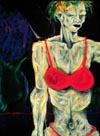
color. In Squeaky, the skin is white, the lips black, the breasts red, the eyes slits,
the ribcage bony and pronounced. And although I let my viewers reach their own interpretations
about these figures, I hardly ever see my protagonists as tragic, as "going down with the ship".
Squeaky willfully survives her own preference for darkness and dissolution.
Sometimes I feel that my images of women have banded together over the years to tribalize
themselves as "the uncivilized women" series. This angularized, tough, self-directed species
projects an innate physicality. They are defiant towards respectable convention. Sometimes
the gender lines seem to blur or transform, like the protagonist of
Deviant Angel.
In The Roxanne Series, such pieces as Ghost Dog, Skywalker,
and As Above, So Below,
follow the spirit of an animal as she journeys through youth and vitality, old age,
and death. Time, place, memory and substance mix and overlap.
As sentient beings, we vibrate with emotion and the nerves of thought. I feel that much of
my work refers cyclically back to this concern. In
Things That Interest Me Visually, I use
my handwriting as characters in a text, relishing the innate tension of my own scrawl, as well
as the phrases it constructs. Some pieces, like Gray's Anatomy,
superimpose elements of
science, medical bondage, and taut, eccentric portraiture. In
Yoga for Manic Depressives
we sense the constriction and confusion of an otherwise lithe and healthy woman.
One of my favorite influences is the art of the 15th century, in both the Netherlands and Italy.
I love the fluidity, balance and mysticism of Fra Angelico, Masaccio, and Piero della Francesca.
From both cultures I am drawn to the severe beauty of the iconographic Christ on the Cross, the
Man of Sorrows, Ecce Homo.
I never tire of looking at the human face. The poignancy and emotion of the 15th century Flemish
artists continuously strikes me. I greatly admire the works of Petrus Christus, Robert Campin,
Dieric Bouts, and, of course, Rogier van der Weyden, to whom I pay homage in the mixed media
photo piece, We Sell Used Gods (not on this site). On a recent trip to the Art Institute
of Chicago, I was struck
by Dieric Bouts Mater Dolorosa (Sorrowing Madonna). I sometimes carry a postcard of the
image with me, a little icon that electrifies whatever space it inhabits.
The approach in these works is thoroughly mixed media. Some of the images may be oil on canvas,
while others mix the likes of acrylic, enamel, graphite, photoemulsion,
pink-pickled-eggs-bought-on-Easter-in-Wisconsin, and decaying wood. Like many artists, I have a
deep-seated need to make marks. I love to scrawl and scratch. I like to dissolve paint on a
surface as much as I like to impact it. I like to encrust dense pastes of pigments, mix a
thick soup, then scrape away to see what's underneath.
As I thus create, destroy, create, the figures which this process define play out their
struggle with the classic Enigma of Self.