Viscosity Monotypes
The whole world is a circle. All of these circular images reflect the psyche. -Joseph Campbell, The Power of Myth
The landscape is a metaphor for the psyche. Although on one level about a sense of place, this body of
work is also about a) energy and b) mind. As such, I return to the individual's psyche, and the energy
it generates, as the content of my art. As Francis Bacon has said: "An artist can only want to record
one's own feelings about certain situations as closely to one's own nervous system as one possibly can".
I am a nonlinear thinker who creates nonlinear compositions. These fitful images show the inherent poetry
of nature, always in a state of flux. As sparks fly about these landscapes, the psyche struggles to exist
comfortably with its innate contradictions.
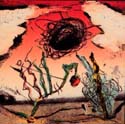
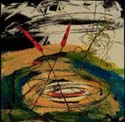
Recurrent motifs inhabit the viscosity landscapes: immense clouds, heat and water pools, fissures, ocean
rivulets and sketchy, vertical notations for plant life. The big skies are punctuated with fast, edgy
scrawls, somewhat like a taut graffiti. In desert-like patches, circular twists push through the veins
of the ground.
What about the place in "the sense of place"? Growing up in New England, and having gone to college in Maine,
it would be hard not to have a strong sense of place. As a youth, I went on long, solitary photo shoots,
roaming through the cold fishing ports of Gloucester, Ipswich, Salem, and Marblehead. Many of the works
in this series are based on a much later connection to place. The Southwest, and my mental reinvention of
it, continues to inspire my visual imagination: the huge skies, wide fields, desert patches, and the country
crosses of New Mexican gravesites.
In Dancing with the Dirt People there are no visible people, but
there are spirits delighting everywhere.
This piece comes out of my feelings for the sacredness of the land in New Mexico.
Happy South of the Border and Scribbling at Venice Beach
are part of The Small Perfect Heat Series.
United by a glowing melon of color, these works are about heading south through California to Mexico,
in search of warmth, solace and inspiration. You Never Knew You Had This,
That Place You Knew, and
My Most Favorite Place, are about memory and experience. What is consciousness, but what occurs at
this very second, and the memory of everything else? Childhood memories so clearly evoke for us the many
mysterious places our young imagination inhabited. The compositional tension in these pieces relates to
the restlessness of an interior landscape, even when the protagonist is enjoying herself.
Some of these images are based on sites of enigmatic, scarred desert gardens. The vitality of the scarred
desert garden or grove is an important symbol in the struggle of the psyche and the soul. Historical pictures
abound of St. Jerome tortured by demons in the desert, and of Jesus anguished by temptation in Gethsemane.
People often ask me about the titles of my work. Since these images seem to come out of some subconscious place,
it is fitting that their titles are a reflection of that. They are more about a work's poetic essence than any
exact meaning, and often reflect a metaphysical bemusement. The titles are another hit of energy, another
layer of consciousness, for the piece to exist within.
The Viscosity Technique
The images in this series employ the viscosity method of monotype printmaking. Viscosity is a resist
technique in which oil-rich colors repel oil-lean or "dry" colors that are put over them. I start by
making a selection or "palette" of colors. These colors, which I will later paint on a Plexiglas or
metal surface (known as the plate) are mixed with a generous amount of oil. I wield a loose, fast brush,
loaded with oil-rich ink. It's anti- illustrational. I paint freely and intuitively, one visual notation
leading into the next. In an additive and reductive method, I continue a rhythm of painting, wiping some
areas totally clean. (It is important to remember to leave some areas of the plate blank for the dry,
top-rolled color to eventually go). One must also visualize the overall effect of adding this top-rolled
color, as a uniting or contrasting element.
Inspiration is found in the energy of the mark-making itself. Why is, for me, making a circular mark, (big,
wide, open, fast), curves and arcs, (in a frenzy, repeated), so natural, so pleasing, and almost primeval?
My primary gestures are scrawls and graffiti-like "scratches", jabbing the inky plate with a pointed skewer
tip, essentially scraping the ink, pushing it, in rapid circular twists: making way, accommodating a place,
for the dry top-rolled color to go. I scrape, circle, twist. The physicality I feel in making these prints
belies the intimate dimensions of my actual playing field.
I then prepare my dry "top roll" by mixing a desiccant, magnesium carbonate, to whichever color I choose,
often a velvety black. Although any dry color can be rolled on top for the resist to take place, my "graphic
edge personality" means that I often select black: sensuous, velvet, forgiving, all-encompassing, and tight:
black. In one complete, non-stop motion, the roller is passed over the entire plate. This dry ink is resisted
by the oily inks and deposited only in the areas left completely blank (or wiped clean in the image-making
process). Sometimes the result is a partial resist, and a blending of color will take place. This unique
texture of resist and partial-resist is the hallmark of the viscosity technique.
The dramatic combination of control, intuition and chance can be very alchemical, as if you are performing the
magician's art! The viscosity monotype has a great fluidity and immediacy making it one of my preferred
approaches in image-making.