2001-2002
After an initial adjustment to the Midwest, the year 2001 saw a renewed period of creative
investigation. Between January 2001 and Spring Break, I began work on the Chronic Case series.
These are viscosity monotypes in which swirling forms turn into alchemic vessels. The bowl or
cup motif is a recurrent (20+ year) theme found in many of my works. It suggests: to be round,
warm, to hold in your hands; to cup, to cradle; to focus, to contain, to go within; from tears
in a coffee cup to organs in a canopic jar. My hand seems to make these forms by itself. The
title "Chronic Case" refers to issues of ease / dis-ease and coping with unsettling interactions
of body and mind. This theme of tension / relief / tension impacts most of my work.
During Spring Break, when for once the prospect of Whitewater as a ghost town seemed very
attractive, I found myself in a wonderful distraction-free immersion of creative research.
Many ideas and visual images came rushing to me during that period of quiet and concentration.
I want to comment on the ideas that were generated and the techniques and aesthetics of a new
direction.
It was Easter week, and I was sitting in Whitewater, Wisconsin: The time and the place coalesced,
sparking a clarity of thought and image, the re-emergence of recurrent themes. The ideas are fluid
in respect to this and future work: Sex, Love and Death. Catholicism and Voodoo. Catholicism and
Sex. Transgression. As a wayward Catholic with a particular love for Crucifixion iconography, I
was compelled (for the first time in 20 years), to find the local Stations of the Cross on Good
Friday. I happily stumbled upon the Latino "Passion of Christ" before the white folks (that
reminded me of the homogeneous New England upbringing that I had escaped), emerged. Of the
ideas that came streaming out, here are three that form an iconographic framework for the
direction of my current visual research: #1. Oddity and Difference. (And then, not only being
perceived as "different" but making a difference). #2. Monoculture Mesmerism. (Ignorance is
Bliss). #3. Transgression. (Socially, Sexually, and, of course, Politically, as in Thoreau's
anarchistic dissent).
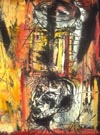
During that Easter week, I began working in a new direction of full sheet (22" x 30") bleed prints
technically constructed upon a loosely overlapping system of segment viscosities. The images were
first drawn as contour line compositions on a large Plexiglas plate. This provided the structural
framework for the loose, fluid and expressionistic painting. The prints were a sensation-charged
experience painted vertically on an easel. The drips and dribbles were integrated into the whole.
I selected a new limited palette for myself in warm earthy colors. The works in this new direction
include: Welcome Home #1, Alchemic
Clinic, Hobo's Lullaby (Woody Guthrie), and
Nice Voodoo, Thinking of You.
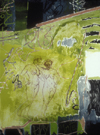
During the summer, teaching in San Francisco, I continued these formal and thematic concerns. I
was thinking of the experiential space that vacillates between work and play, and in the idea of
"adult playmates". I wanted the body to tell its story, no matter how disconcerting. There are
hints of carnal knowledge (Private Playmate), transgression
(Barely Ever Legal),
intellectualism vs. raunchy sex (Work and Play / Professor Paglia),
and how love, after awhile,
becomes an affliction (Love and War / Playmate). The individual's
transgression within and against societal norms is the essential theme of the Barely Ever
Legal series.
The formal design of these pieces is multi-episodic in nature, often built up in grids of segment
viscosities and relative opacities of ink. I have relished the use of words within these works-
not only in their potential for multiple layers of meaning
(Keep your Bags Packed), but in their
purest mark-making sense. Some images incorporate transfer techniques, drawing, intaglio,
transparency, and pierced surfaces (i.e. grommets).
It has been a pleasure to be so engaged by the making of these unsettling images, which seem to
mirror my personality. As the artist Francis Bacon once said: "All one can hope to do is make
paintings which are as close to one's nervous system as one possibly can".